

For a long time, the medtech growth model had a very familiar rhythm. Build the product, create the clinical evidence, hire the sales team, get in front of the right physicians, and ask them to try it on the next appropriate patient.
That model helped build a lot of successful companies, so I do not think the old playbook was wrong as much as I think the market around it has changed. Clinical evidence still matters, relationships still matter, and strong sales execution still matters, but none of those things work the same way when the buying environment has become more complex, more operationally constrained, and more financially scrutinized.
That was the heart of our conversation in this week’s Medtech Business Academy episode. The companies that are winning today are not simply better at selling their products. They are better at understanding the environment those products have to enter.
The Physician Is Still Influential, but the System Has Changed
One of the biggest shifts is physician employment.
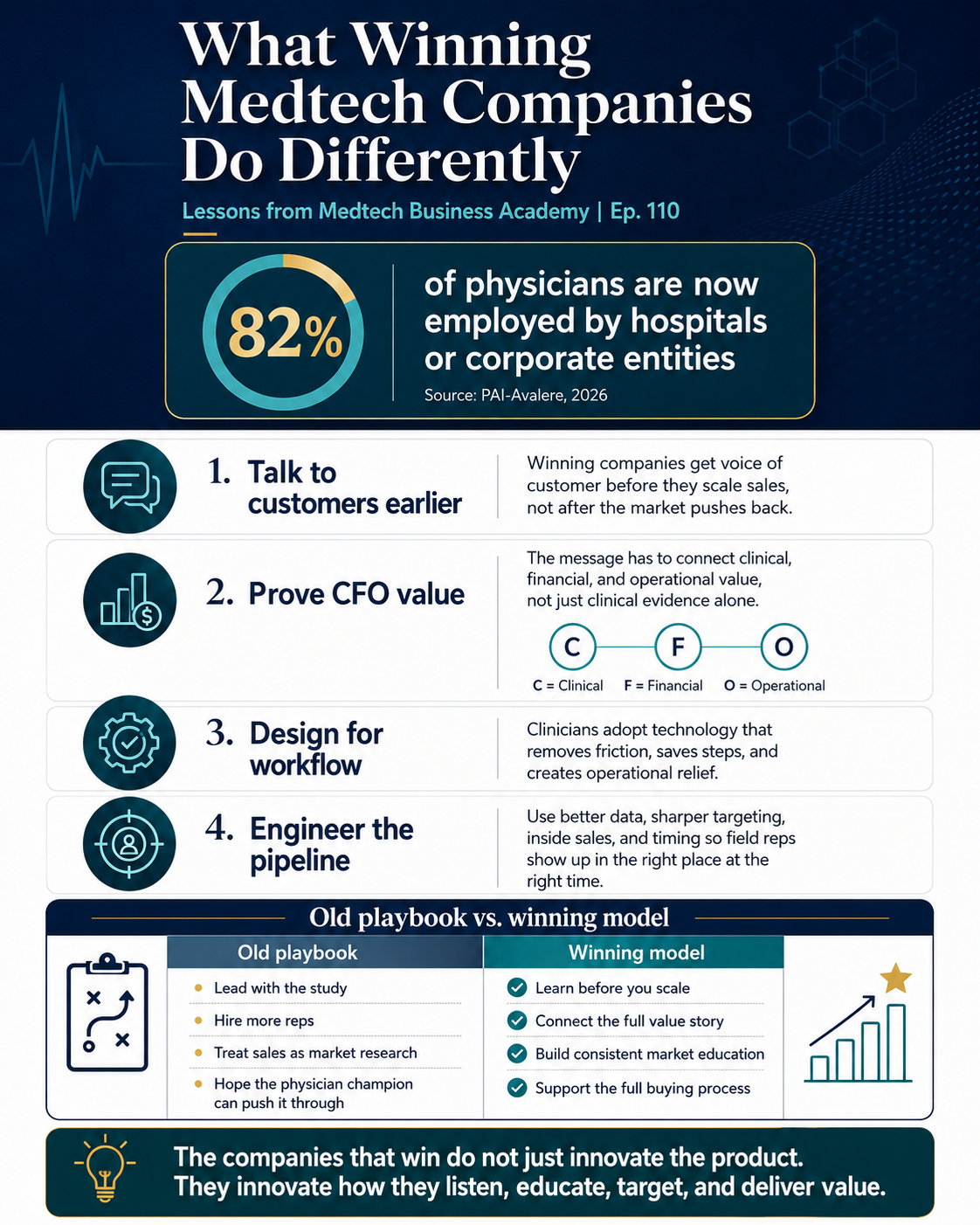
82% A recent PAI-Avalere report found that 82% of physicians are now employed by hospitals or corporate entities. Whether someone wants to debate the exact number or not, the direction of travel is impossible to ignore.
The physician who once had broad independence over product choice is now much more likely to operate inside a system, and that system has its own committees, cost pressures, workflow requirements, contract structures, and operational guardrails.
That change affects everything. When a physician owned the practice, controlled more of the purchasing decision, and had more freedom to trial a new product, the sales conversation could often be direct and transactional. If the product made clinical sense and the physician trusted the rep, adoption could start quickly.
Today, that same physician may like the product and still not have the authority to use it tomorrow. They may need to bring it to a committee, understand how it affects procedural cost efficiency, consider the value analysis process, account for training burden, and explain whether the product creates operational relief or simply adds another step to an already strained clinical day.
Customer Feedback Cannot Wait for the Sales Report
That is why I think one of the biggest mistakes medtech companies make is waiting too long to talk to customers. Too often, the assumption is that real market feedback will come once the sales team gets into the field, which means the company raises money, hires reps, starts calling on accounts, and then treats the sales report as the market research.
That is a very expensive way to learn. If you find out six months into the process that your sales cycle is eighteen months, that your economic story is not strong enough, that your product adds workflow burden, or that the clinical champion cannot move the decision without value analysis, you have not just gathered information. You have burned time, capital, and momentum.
The companies that are doing this well are getting voice of customer much earlier. They are not just asking whether clinicians like the product, because almost every company can find someone who likes the clinical idea. They are asking what it will actually take for the product to be evaluated, approved, adopted, taught, supported, and used consistently.
That distinction matters because a product may save money on paper while still adding three steps to a nurse’s day. A technology may improve efficacy by a few percentage points while creating a conversion burden that leadership does not believe is worth the disruption.
The Value Story Has to Connect Clinical, Financial, and Operational Priorities
This is where the clinical, financial, and operational story has to come together. In the old model, many companies were comfortable leading with the clinical claim, which usually sounded like, here is the study, here is the outcome, and here is why the product works. In today’s market, that is necessary, but it is not enough.
The winning companies can explain the clinical value, the financial value, and the operational value in one connected story. They can show why the product matters to the physician, why it makes sense to the value analysis committee, why it does not create unnecessary burden for staff, and why the organization should prioritize it now instead of pushing it into a long queue of things that sound interesting but never move.
Pipeline Is Oxygen
The same discipline applies to pipeline. Mike made a very important point in the episode when he said that pipeline is oxygen, and I agree with that because growth becomes theoretical very quickly when a company does not know who is in market, who has influence, who has a problem, who is under contract, and who is actually ready for a conversation.
Too many companies still define their target account too loosely. They know a site performs the procedure, uses a category of product, or has a piece of capital equipment, so that site becomes part of the call list. Then expensive field sales resources spend months trying to find out whether the account is even worth pursuing.
That is not strategy. That is discovery at the highest possible cost, and in a funded company with limited runway, it can become one of the fastest ways to confuse activity with progress.
The companies that are winning are more disciplined. They invest in better data, use inside sales intelligently, understand where volume is, map the stakeholders earlier, identify timing, and then put the right sales resource in the right account at the right time. That does not remove the need for field sales, but it makes field sales more effective because the rep is no longer being asked to do every job in the commercial process.
The Commercial Model Must Evolve With the Market
Outside sales still matters. Human relationships still matter, and complex medtech selling still requires trust, expertise, and in-person presence at the right moments. The issue is that the idea of solving every growth problem by hiring more field reps belongs to a market that no longer exists in the same form.
Winning companies are rethinking the full commercial structure. They are using marketing to educate the market consistently, customer feedback to sharpen the strategy earlier, data to improve targeting, inside sales to build and qualify pipeline, and field sales to advance the right opportunities when the timing and account dynamics make sense.
That may be the most important point from the episode. Medtech has always been proud of innovation, but we usually define innovation as the device, the technology, the software, or the clinical solution. The companies that are winning now are also innovating how they go to market, how they listen, how they educate, how they build trust, and how they prove value to a system that has more stakeholders and less tolerance for disruption.
The market has changed, the physician has changed, the buying committee has changed, and the expectations around workflow, cost, and adoption have changed, which means the companies that win will be the ones willing to change with it.