
Medical Device Commercialization
The Post-Clearance Playbook: How MedTech Leaders Bridge the Gap Between 510(k) Approval and Hospital Adoption
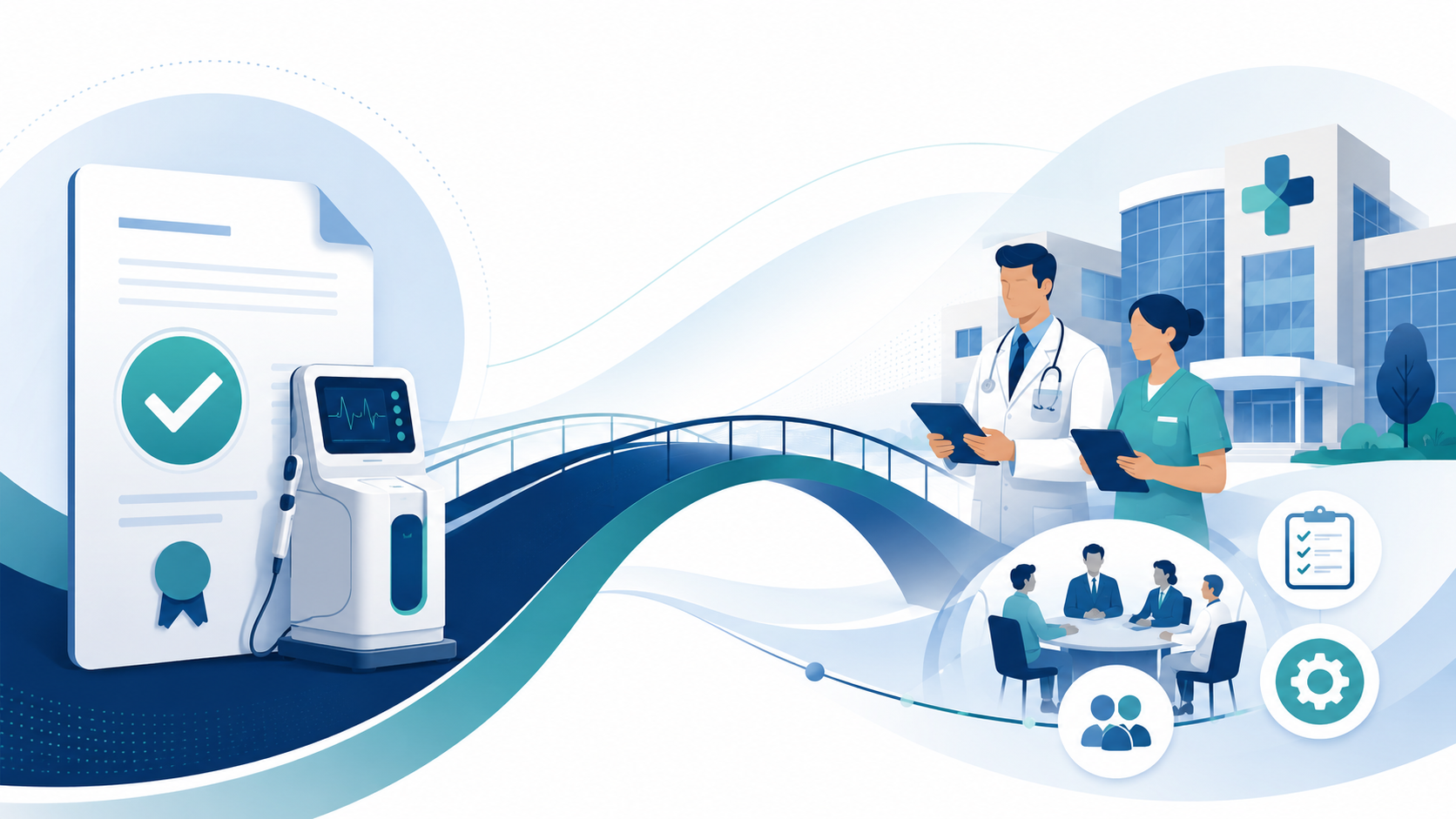
FDA clearance gets a medical device to market. Commercial adoption depends on what happens next inside the health system.
Securing FDA clearance or PMA approval is a monumental milestone for any MedTech company. It represents years of engineering discipline, rigorous clinical trials, and capital investment.
When the decision letter arrives from the FDA, leadership teams understandably celebrate. But once the dust settles, executives hit a sobering operational reality: FDA clearance is a milestone, and also the starting line for commercial adoption.
Regulatory approval proves that a device is safe and effective under controlled conditions. It does not prove that a health system will buy it, that a Value Analysis Committee (VAC) will approve it, or that a busy nurse on a 12-hour night shift will actually use it.
Crossing the gap from FDA clearance to commercial velocity requires shifting your strategy from regulatory compliance to human-centered adoption.
The Shift: From Regulatory Benchmarks to Human Questions
In the pre-clearance phase, your world revolves around objective metrics: bench testing data, predicate device comparisons, safety endpoints, and regulatory submissions.
Post-clearance, the evaluation criteria become intensely human and operational. Success is no longer decided in regulatory review offices; it is decided in hospital hallways, supply closets, and procurement committee rooms.
To drive rapid commercial adoption, MedTech leaders must answer five core human questions:
Is Value Obvious to Everyone Involved?
A clinical innovation rarely fails because it lacks efficacy. It fails because its value proposition is clear to only one stakeholder group. A novel catheter might save a surgeon three minutes in the operating room. But if it costs 40% more than the legacy device and requires a complex sterilizing procedure that burdens materials management, the system as a whole sees a net loss. Value must be obvious simultaneously to clinicians, supply chain managers, IT specialists, and financial executives.
How Will the Product Fit into an Already Overloaded Workflow?
Healthcare professionals operate under severe time constraints and cognitive overload. If adopting your device requires three extra clicks in the EHR, a separate login, or a non-standard prep sequence, adoption will stall, regardless of how superior your clinical outcomes are. If a technology causes friction during a busy shift, clinicians will naturally revert to legacy solutions that require less cognitive load.
Will They Try It?
Trialability is the first hurdle of field deployment. How high is the barrier to entry for a clinician’s initial evaluation? Does trying your product require an intensive four-hour training module, or can a physician grasp the core operational mechanics in a two-minute brief? Lowering the initial barrier to trial is essential for building early internal momentum.
Will They Buy It?
Physician advocacy opens the door to hospital access, but advocacy alone no longer signs contracts. Modern hospital purchasing goes through Value Analysis Committees (VACs), which operate on strict financial and operational metrics. If your team enters a VAC meeting with only clinical data and no clear economic impact framework or reimbursement pathway, the file will sit on hold indefinitely.
Will They Keep Using It?
Initial orders and hospital evaluations can create a false sense of security. The true measure of commercial viability is utilization frequency 90 to 180 days after the sales rep leaves the floor. If reorder rates drop, it is a warning sign that the device introduced hidden operational friction that was never uncovered during development.
The Hazard of Relying on Lagging Indicators
The traditional MedTech commercialization model relies heavily on post-launch field feedback. Companies deploy field sales reps, wait six to twelve months, and then analyze sales reports to determine why adoption isn’t scaling.
This approach relies entirely on lagging indicators:
- Extended 14-month sales cycles
- Low reorder velocity after initial evaluation kits are exhausted
- High rep turnover due to stalled hospital committee reviews
- Discounting pressure during final procurement negotiations
By the time lagging indicators surface on a balance sheet, millions of dollars in commercial capital have already been spent. Worse, the sales team is left attempting to diagnose whether the root issue is pricing, clinical perception, or workflow friction.
Replacing Speculation with Direct Clinician Insights
Winning MedTech organizations do not guess how the market will react post-clearance. They gather qualitative, actionable insights from real clinicians before scaling their commercial footprint.
By engaging practicing physicians, surgical nurses, and hospital procurement leaders early, MedTech teams convert hidden operational roadblocks into actionable strategies:
- Uncovering Workflow Friction Early: Identify usability issues while product positioning, packaging, and training materials can still be adapted.
- Streamlining the VAC Submission: Formulate economic impact frameworks that align directly with hospital administration priorities.
- Optimizing Training & Onboarding: Design deployment materials that respect clinician time constraints and accelerate mastery.
How TCX Accelerates Post-Clearance Commercialization
At TCX (The Clinician Exchange), we eliminate the guesswork from MedTech commercialization. We do not offer abstract consulting or surface-level market reports. We provide direct access to an active network of 20,000+ practicing clinicians and hospital administrative leaders .
Whether you need to test your VAC presentation with actual procurement committee members, evaluate workflow fit with emergency department nurses, or refine clinical messaging with specialist surgeons, TCX bridges the gap between your leadership team and the frontline professionals who dictate commercial adoption.
FDA clearance gets your device into the market. Authentic clinician insights ensure it gets used.
Before the next launch meeting, ask ten better questions.
Download The First 180: 10 Questions Every Commercial Team Should Ask About Adoption.
Download The First 180